

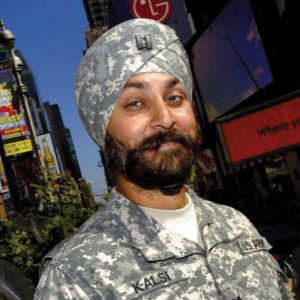
Lt. Col. Kamal S. Kalsi
The history of the two world wars and succeeding conflicts shows diversity only strengthens a nation’s security forces, and that holds true for fighting the complex enemies of this century, according to an Indian-American officer in the U.S. Armed forces.
Lt. Col. Kamal S. Kalsi, an ER doctor has served for 17 years in the U.S. Army and was deployed to Afghanistan. He currently serves in U.S. Army Reserve at Fort Dix, New Jersey, as a disaster medicine expert.
In an interview with News India Times, Kalsi, who specified that his views were his alone and did not reflect those of the Department of Defense or the U.S. Army, dwelt on the issue of diversity, the role Indian soldiers played in World War I and World War II; about the principles that underlie the making of the United States of America, and what diverse groups like Native Americans, African Americans, even Japanese-Americans many of whose families were put in internment camps, embodied that diversity and played a key role in the U.S. Armed Forces.
“Diversity is a strategic imperative,” Kalsi said. “Why would you put yourself at a disadvantage when fighting such a complex enemy in this day and age – like terrorism and cyberwars. You would want the best and the brightest.”
According to him, “Without the forces from India, the Nazi tide would not have turned. The role of Indian forces is greatly underplayed. Indians sacrificed so much. They fought in Tripoli, Jerusalem, North Africa, Japan… They were in some of the most difficult theaters of war,” he said, adding that some 80,000 Sikhs alone were killed in World War II.
In the U.S., he said, awareness about the benefits of diversity are being felt and the armed forces are struggling to meet this goal. “There has been significant progress in the last ten years,” Kalsi told News India Times, including the change in regulations this January allowing Sikh turbans, Muslim hijabs, and African cornrows in the U.S. Army, though not yet in the Air Force or Navy.
In a speech at an Association of U.S. Army (AUSA) event recently, four-star General Mark Milley, chief of staff of the U.S. Army, said the nation was built on an ‘Idea’ which says, “That all of the people, regardless of whether you are male or female; it doesn’t matter if you are gay or straight or anything in between; it doesn’t matter if you are black or white or Asian or Indian, or any other ethnic group; it doesn’t matter what your country of origin, or the spelling of your last name; it does not matter if you are Catholic or Protestant, Muslim or Jew, or if you do not believe at all, it doesn’t matter if you are rich or poor or common or famous.
In this country- all Americans are created free and equal, and we will rise or fall based on our merit, and will be judged by the content of our character, not the color of our skin. That is the organizing principle of the United States of America- and that is why we fight.”
Despite these fighting words, there continues to exist an “institutional discrimination” that makes diversity a difficult goal to achieve in the forces, Kalsi contends. He cites as an example his own brother, Dr. Ranjeet Singh Kalsi, who has been trying for two years to join the U.S. Air Force as a doctor, one who has topped his class in every way, and who has not been sent a formal rejection letter.
Lt. Col. Kalsi recently launched an organization, the Sikh American Veterans Alliance (SAVA), which contrary to its name, is not restricted to Sikhs, he says, but rather has the goal of improving diversity in the U.S. forces for all races and ethnicities. It will be launching its website on Veterans Day Nov. 11.

Ela Dutt
| Editor, Parikh Worldwide Media

Leave Comments